Showing posts with label USA. Show all posts

Wednesday, 6 July 2016

Morbid Angel: Illud Divinum Insanus – Is it Really that Bad?

Hello again internet! I know it's been an age since I last graced the international blogosphere with my presence, but you'll be pleased to know I'm not dead.

Instead I have been away in the cruel and lonely world of academia, finishing off my studies. These included a poetry portfolio - some of which I might post here later on - and a 12,000 word dissertation on the changing face of the global Metal culture. These included the role of women, racism, homophobia, etc.

But to recharge my place in the international blogosphere, I thought I'd publish here my thoughts on one of the most hated Death Metal albums of recent history.

Ladies and gentlemen and third gender, I give you my thoughts on Morbid Angel's Illud Divinum Insanus.
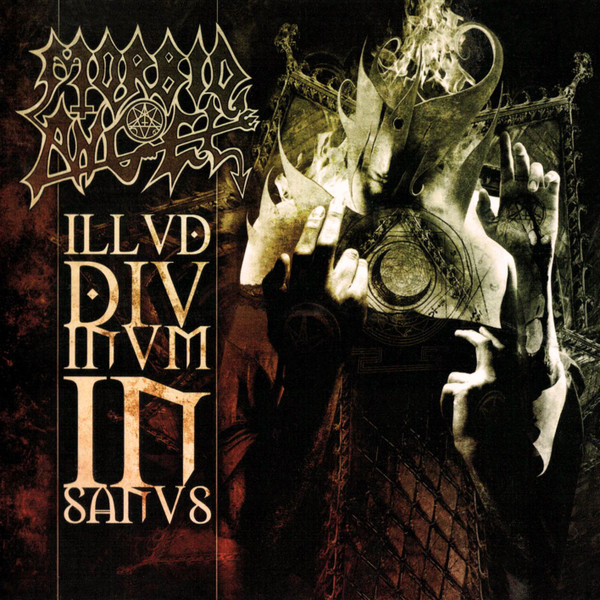


June 2016 marks the fifth anniversary of American Death Metal band Morbid Angel’s eighth studio album Illud Divinum Insanus (Divine Crazy). This album received mixed to lukewarm reviews from the press, but I as a fan of the band, can recall the hefty backlash of angry fans who felt their beloved Death Metal veterans had betrayed their musical roots and had delivered what some have gone as far as calling: ‘mandatory suicide.’

Seeing as how it’s been five long years with no new material since, I think it’s time to see if this album has stood the test of time and ask: is it really that bad? 

A Brief History

Before I delve into the album I’ll just give a brief history of the group. 

Formed in Tampa in 1984, Morbid Angel is one of the earliest Death Metal bands who pioneered the genre at the beginning of the 1990s. Along with fellow Florida bands Death, Deicide and Obituary, their use of growled vocals, down tuned guitars, complex rhythm and string structures and focus on blasphemous and occultist lyrical themes; gave birth to what is deemed the most extreme Heavy Metal genre by many.


Illud Divinum Insanus

The first thing you notice about this album is that it’s experimental. You begin by hearing some eeriness that reminds you of cheap b-movie horrors which the band must have used as influences, but soon you hear some odd bass and drum programming that has lashings of Industrial music to it. 

But eventually the tracks begin to drag with first vocal driven track ‘Too Extreme’ annoying the listener with what sounds like a DJ scratching some vinyl over some double bass pedals which you can tell aren’t being played by human feet. Every now and again you hear some guitars reminding you of Morbid Angel in their recent days but the song drags and goes on for too long making you want to turn it off – not the best of starts.

Then you’re subjected to ‘Existo Vulgore’ which sounds a little more like the band you came to listen to. Morbid Angel laid some of the cornerstones of Death Metal so they’re not technical in nature and instead play basic extremes of guitars and drums. This track and next one ‘Blades for Baal’ would make any keen Death Metal listener think of this American classic act. 

David Vincent - Divinely & Utterly Crazy
However, the biggest let down of this entire album is vocalist David Vincent. He’s  known for his death growl vocals which have aided in making classic Morbid Angel albums: Covenant, Altars of Madness and Blessed Are The Sick, bestsellers in the Death Metal canon – but here it feels like he’s trying to ‘speak-growl’ not be as brutal as possible. There are even places where he sounds like he’s rapping, especially on track ‘I Am Morbid’ – something I can only see as an attempt at the band formulating a new battle cry for fans at live shows. Seriously, that track sounds like a football chant by how it opens with clapping and crowd like yells of the word ‘morbid.’

So overall, I can sympathise with anyone who called this album weak or terrible when they heard it. I for one had to turn it off several times and took the best part of two days to listen through it when writing this piece. But am I going to slag off the band and say it’s time to call it quits after 32 years on the road? Well no, I am not. In fact I’m going to talk about what made this album such a bad thing for the band – not the musical failures but the fans being atrociously immature.

Experimenting and Elitism

So what we have here in summary is an experimental album. An experiment that’s gone horribly wrong. From how fans reacted to this album, it does make me ask: have you never heard of a band experimenting before? Has everyone forgotten about Thrash Metal veterans Kreator flirting with Gothic and Industrial music throughout the nineties?


However, it does appear that this is the first experimental album from one of the major Death Metal bands – I cannot recall others like Obituary, Cannibal Corpse or Deicide blending something radical into their output. I think this is one thing that’s led to me distancing myself from the genre in recent years – other such genres like Black Metal seem a bit more open to bands taking a risky step and going on some audible adventure.
Though what angered me most about this album was how some fans even had the nerve to create Facebook groups like ‘RIP Morbid Angel and go as far as saying they’re ‘traitors’ when commenting on the songs on YouTube.

How I feel about Morbid Angel was best summed up by YouTube blogger Ed Veter (InfidelAmsterdam) ‘Compare it with a good friend. They’ve been doing the same thing you do and then make a choice after so many years, which you do not agree with. Are you putting away your entire friendship just because he or she made a decision that doesn’t really affect you?’


Please do remember all you fellow Morbid Angel fans reading this, I despised this album as much as you, but what is most important to a band and the culture of the music is how the fans behave and I do feel metal is changing in attitude. But please, the next time your favourite group makes a terrifying record like this one – just remember the band did what they wanted to do and you can’t control all of that. 

Plus, they’ll still be playing the music you love at the live shows like I’ve seen in recent years. We just need to understand that being so elitist about what our favourite bands do and don’t do, makes all us metalheads look like the immature, vicious, obnoxious people the outside world is so quick to paint us as.

Tipper Gore - Just one of many people trying to silence Metal and paint us all as stupid. Don't give in to the censors.


Saturday, 11 July 2015

Top 4 Anti Capital Punishment Films


I can’t say I’ve ever held support for the death penalty. Thinking about why, I’ve narrowed it down to four key points: 1) What if they’ve got the wrong suspect? 2) The state in my anarchist viewpoint relies on a monopoly of violence, and there is no greater example of this than a ‘free’ state exercising a law that gives it the arrogance to take away a person’s life. It is the fear that holds up institutions and the forces that keep the people in place. 3) Taking the life of a person, regardless of how evil an atrocity they have committed, will never bring back who or what it was they took from you. Killing a murderer will not bring back the person they took, so how does taking the murderer’s life make us any different from them? And 4) Because life is the most important thing for me, nobody has the right to take it away, or to order it to be taken. This is why I do not support war nor national service, because the state thinks it can have the final say in how someone’s life ends. Every individual must have the final say in how their life ends. This is why I support euthanasia and abortion – in euthanasia it is best to put someone out of their misery because the individual would not want to be in pain, and in abortion a woman must be allowed to do whatever she wants with her body and if she does not wish to have a child it is her choice.

Now enough of my left wing rantings, let’s get down to why you came here. I have thought long and hard about the things that have influenced why I don’t agree with the death penalty and I have lined up the top 4 films which led to me having said opinions.

Ladies and gentlemen and third gender, here are the top 4 best anti capital punishment films. Why 4? Because 5 and 0 do not make everything equal.


I was shown this movie in ethics whilst studying my GCSEs, and it reflects the debate on capital punishment among Christian groups. The film follows the true story of a catholic nun, Helen Prejean (Susan Sarandon) as she gives guidance to death row inmate Matthew Poncelet (Sean Penn) as he awaits his execution. Poncelet has been sentenced for raping and murdering two teenagers – which is depicted in one of the most gruesome scenes I’ve ever seen in a non horror film. 

Prejean is a vocal opponent of capital punishment, and it is her arguments with the protestant prison chaplin which makes up the majority of the film’s message. Why should a Christian oppose or support the death penalty? In my atheist opinions, this is a good reflection of how ferocious debates on topics like this can spring up amongst denominations and splinter groups, be they religious, militant or political. In-fighting is something that has always turned me away from party politics and organised religion so this film is something to look at if you’re curious about how the death penalty is such a big debate in so many circles.

But what makes it such an anti death penalty story, is how the compassion, upset and realisation that this man’s death will not bring justice is seen in the final scenes. As Poncelet is put to death by lethal injection you can see how the parents of the victims and the pro-death chaplin have realised how wrong they really were. It is a scene without dialogue which makes it all the more poignant. And the performances given by Poncelet’s family, including Jack Black certainly shows how having a family member executed is not a service of justice but a humiliation that will hang on innocent people’s shoulders forever.

Whether or not you believe in God, this is a film you must see to look into how the US justice system is in dire need of a reformation.


This is not an overtly anti death penalty film, but how the system is portrayed in a manner only a Stephen King novel can do so, certainly makes you wonder how such a gruesome act of rough justice is still practised today.

It follows prison guard Paul Edgecomb (Tom Hanks) as he recalls the year an innocent black man, John Coffey (Michael Clarke Duncan) was sentenced to the electric chair. Edgecomb discovers that the man possesses god-like powers - such as the ability to heal him of his genital infection and resurrect the dead. 

There is plenty of Christian imagery in this film which again raises the debate on why a supposedly Christian nation should practice such an act of justice. I guess Stephen King wanted to express his wonder at why a religion so bent on forgiveness would legitimise such a non-forgiving act.

Coffey’s execution is certainly on a parallel with the crucifixion, but how it is portrayed would lead anyone with compassion and respect between their ears to shout out ‘why are we still doing this?’ The film is set in the 1930s, but even that wasn’t so long ago and was at the peak of time when the whole world had beaten itself up and was itching to do it again. I have to admit that this film made me realise just how disgusting the electric chair is to put someone to death – it is an abuse of science. 

For anyone who wants to know how brutal a history the USA has with its justice system, this is the film for you – based on the works of one of the finest storytellers of our generation.


Now how else do you tell such an amazing story of how wrong the death penalty is, than chronicle the life of the last man to hold the profession of Executioner in the UK.

Albert Pierrepoint (Timothy Spall) hanged over 600 people in his life, among them the Nazi war criminals sentenced at the Nuremburg trials. After the death penalty was abolished in the UK in 1964, Pierrepoint became allegedly, an opponent of capital punishment. And how else do you know just how wrong the act is, if you took part in it? That for me is the same reason returning soldiers become such vocal anti-war protestors. I am in no way defending what Pierrepoint did, but it is always wise to look into those who took part in something in order to reveal just how wrong something is. It is similar to the story of Albert Speer, the Nazi munitions minister who was spared Pierrepoint’s noose because he plead guilty and apologised for his actions at Nuremburg.

This is also a keen drama to understand why someone would take up such a profession. In one scene, a coffin has not been brought for the man Pierrepoint has hanged and that angers Pierrepoint, leading to his line: ‘This man has been atoned for his wrongdoings, he now deserves a decent burial.’ So whether or not you agree with him, it’s worth watching to understand the logic for a state giving legitimacy to the gallows.
I found this film to be an excellent retelling of a time I’m pleased to say I did not grow up in. Death does not solve problems and this was a film that told me I am not a person who would ever work in a profession that involves taking other people’s lives. For a big part of my teenage years I wanted to be a fighter pilot and it’s films like this that told me I am not someone who would function in any profession where you must take another person’s life – that includes the armed forces.

This is also Timothy Spall’s most stellar performance in my opinion. And I must stress that these films are not to be watched for entertainment value, they are to be watched in order to understand why the death penalty is not something we all agree on.


And the number one anti capital punishment film is...


There is no greater story of British injustice than that of Derek Bentley. Bentley (pictured below) was an 18 year old boy with the mental age of an 11 year old and the IQ of 66. After he left a special needs school he got involved in a gang through peer pressure. One night in 1953, Bentley and the gang leader Chris Craig climbed onto the roof of a cenfectionary warehouse and they were followed by the police. Upon seeing the police, Craig pulled a gun and the unarmed Bentley, scared by all this shouted the eponymous line, which was not a call to open fire but to hand over the weapon.

Craig murdered two policemen and then tried to kill himself. Bentley was arrested and did not resist at all. And when the case came to the high court, the sentence of death was imposed upon Bentley because he was older than Craig (16) when found guilty. Craig served time in a state prison.

However when the sentence was passed, the judge ordered that mercy be considered for Bentley, but despite the public outcry that an innocent man had been sentenced to death, the British government refused to overlook the sentence until the execution had been passed.

I can think of no other story of a man being murdered by the state. It is no wonder Bentley’s gravestone reads: ‘Here lies Derek Bentley – A Victim of British Justice?’ And what is more upsetting is that his sister who spent her whole life campaigning to have his name cleared, did not live to see the day he was finally acquitted in 1998.

As for the film, there is no other movie I can recall that has made me cry uncontrollably. This is an example of a government wanting to crack down on a nation’s special needs population and is the film to show to any Brit who shouts ‘bring back hanging!’ Ironically, Bentley was hanged by Albert Pierrepoint. 

Anyone who has ever felt the death penalty should be reintroduced to this nation – I urge you to watch this film. This was Christopher Eccleston’s first film, and perhaps the finest performance he has ever given. 

Speaking as someone who qualifies as special needs, I cannot fathom how the judicial system of 1953 could ever have considered putting a young man in need of aid to the noose. This country claims to have the best justice system in the world, but it hasn’t the cleanest of pasts. Let anyone who campaigns for the reintroduction of the gallows see this film.